Climate-Adapt4EOSC cited in new article on FAIR, knowledge-driven research infrastructures
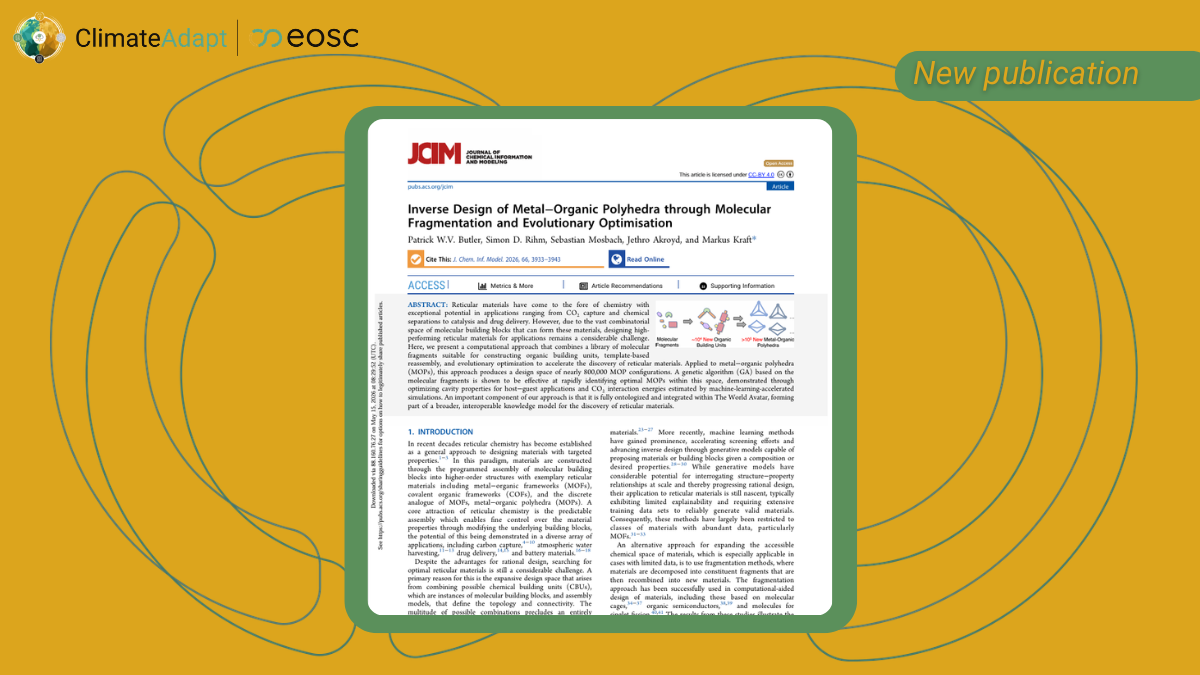
Climate-Adapt4EOSC is pleased to note that the project is referenced in the paper titled “Inverse Design of Metal–Organic Polyhedra through Molecular Fragmentation and Evolutionary Optimisation”, published in the Journal of Chemical Information and Modeling.
Although the article is not a direct output of the Climate-Adapt4EOSC project, it provides a useful example of how FAIR principles, semantic technologies, knowledge graphs, and interoperable digital infrastructures are being applied across data-intensive research domains.
About the article
The article presents FragMOPs, a computational workflow for the inverse design of metal–organic polyhedra. While the scientific focus is on materials discovery, the work is especially relevant from an open science and research infrastructure perspective.
FragMOPs is implemented as part of The World Avatar, described by the authors as “a dynamic ecosystem of interconnected data and knowledge models built on FAIR principles.” Through this integration, the workflow links to chemical knowledge bases such as OntoSpecies and is designed to interoperate with complementary knowledge models including OntoCompChem and OntoPESScan.
Connection with Climate-Adapt4EOSC
Climate-Adapt4EOSC is working to support climate adaptation research through an EOSC-centred collaborative research environment that improves the way data, models, methods, publications, code, software, and services are discovered, connected, reused, and managed across disciplines.
This mission is inherently interdisciplinary. Climate adaptation research draws on climate science, environmental modelling, social science, policy, planning, infrastructure, health, economics, and other fields. To support this diversity, researchers need digital environments that make heterogeneous knowledge sources easier to find, align, interpret, and reuse. By contributing to the broader European Open Science Cloud (EOSC) vision, Climate-Adapt4EOSC aims to help transform fragmented research outputs into connected, reusable knowledge for climate adaptation and resilience.
Over the course of the project, Climate-Adapt4EOSC will develop a repository of relevant publications and research outputs. This will include publications produced directly by the project, as well as articles and outputs that are indirectly influenced by or connected to the Climate-Adapt4EOSC project.
Read the article
Butler, P. W. V., Rihm, S. D., Mosbach, S., Akroyd, J., & Kraft, M.
Inverse Design of Metal–Organic Polyhedra through Molecular Fragmentation and Evolutionary Optimisation.
Journal of Chemical Information and Modeling.
DOI: 10.1021/acs.jcim.5c02956.