FAIR2Adapt publication highlights shared EOSC goals for climate adaptation data
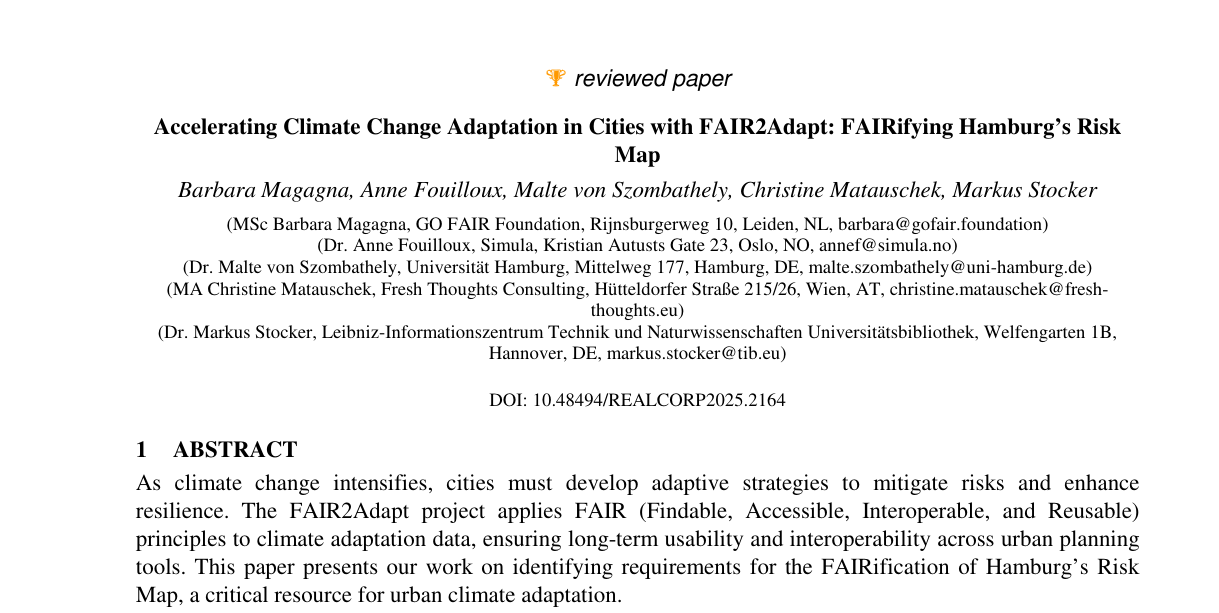
Climate-Adapt4EOSC is pleased to highlight the publication of “Accelerating Climate Change Adaptation in Cities with FAIR2Adapt: FAIRifying Hamburg’s Risk Map” by Barbara Magagna, Anne Fouilloux, Malte von Szombathely, Christine Matauschek, and Markus Stocker, published in the proceedings of REAL CORP 2025. The paper presents work from the FAIR2Adapt project on applying FAIR principles to urban climate adaptation data, focusing on requirements for the FAIRification of Hamburg’s Risk Map. It connects directly with Climate-Adapt4EOSC, which is working to support FAIR, interoperable, and EOSC-aligned climate adaptation research by improving how data, models, services, and research outputs are discovered, connected, reused, and managed across disciplines. FAIR2Adapt and Climate-Adapt4EOSC are sister projects within the EOSC ecosystem, sharing a common ambition to transform fragmented climate adaptation information into transparent, reusable, and actionable knowledge for resilience planning.
Abstract
As climate change intensifies, cities must develop adaptive strategies to mitigate risks and enhance resilience. The FAIR2Adapt project applies FAIR principles — Findable, Accessible, Interoperable, and Reusable — to climate adaptation data, ensuring long-term usability and interoperability across urban planning tools. This paper presents work on identifying requirements for the FAIRification of Hamburg’s Risk Map, a critical resource for urban climate adaptation.
The authors outline a methodological framework to enhance data findability, accessibility, and interoperability by integrating the Risk Map with broader urban data infrastructures. Their approach includes requirements elicitation as a pre-phase of the FDO-driven FAIRification Framework developed in FAIR2Adapt. Based on the Hamburg case study, one of six FAIR2Adapt case studies, the paper identifies user stories and more specific requirements, including the need for FAIR Supporting Resources such as a FAIR metadata schema for geospatial risk maps and simulation models, improved data sharing and reusability within ArcGIS-based risk assessment tools, Scientific Knowledge Graphs such as the Open Research Knowledge Graph, and RO-Crates for packaging software with structured documentation.
By embedding FAIR principles, the work aims to strengthen decision-making for urban climate adaptation by providing city planners and stakeholders with actionable, interoperable data. The paper also discusses challenges in FAIR implementation and considers how the approach could be scaled to other cities, contributing to the broader discussion on how FAIR principles can accelerate climate resilience in urban environments.
Publication details
Item Type: Article
Uncontrolled Keywords: climate change, resilience, climate adaptation, interoperability, urban planning
Subjects:
G Geography. Anthropology. Recreation > GE Environmental Sciences
H Social Sciences > HD Industries. Land use. Labor
T Technology > TA Engineering (General). Civil engineering (General)
Depositing User: REAL CORP Administrator
Date Deposited: 16 May 2025 08:39
Last Modified: 07 Jul 2025 10:19
URI: http://repository.corp.at/id/eprint/1157