New publication: scenario-based modeling for exploring urban cooling pathways -a targeted, health-relevant approach toward just resilience-
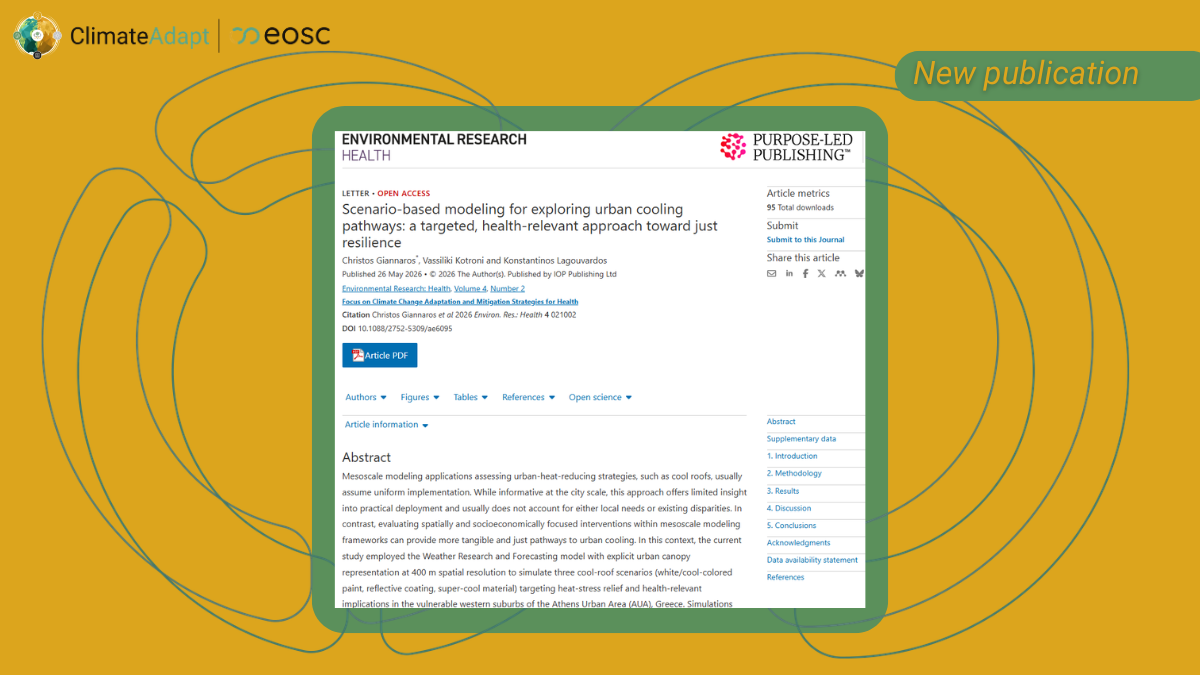
Climate-Adapt4EOSC is pleased to highlight a new open-access paper funded directly by the project, titled “Scenario-based modeling for exploring urban cooling pathways: a targeted, health-relevant approach toward just resilience”, published in Environmental Research: Health.
Co-authored by Christos Giannaros , as well as Vassiliki Kotroni, and Konstantinos Lagouvardos from the National Observatory of Athens, the study addresses a critical gap in European urban planning by demonstrating how spatially and socioeconomically focused cooling interventions can advance climate adaptation and social equity.
About the article
Traditional climate modeling applications often evaluate urban cooling solutions, such as cool roofs, by assuming uniform, city-wide implementation. While informative for estimating theoretical maximum impacts, this approach overlooks practical deployment constraints and fails to account for localized needs or existing socioeconomic disparities.
To overcome this limitation, the authors developed a novel, vulnerability-oriented framework. Utilizing the Weather Research and Forecasting (WRF) model with an explicit urban canopy representation at an ultra-high 400-meter spatial resolution, the study simulated three cool-roof scenarios (white/cool-colored paint, reflective coating, and super-cool material) in the Athens Urban Area (AUA), Greece, during a severe nine-day extreme heatwave.
Crucially, the intervention area was strategically positioned within the Elaionas industrial zone to leverage natural sea-breeze circulations, effectively directing cooled air toward the lower-income, heat-sensitive western suburbs of Athens. The targeted cool roofs produced a clear atmospheric cooling effect, reducing mean daytime near-surface air temperatures by up to 0.73 °C during sea-breeze conditions. By integrating demographic data and thermophysiologically grounded health indicators (modified Physiological Equivalent Temperature, or mPET), the study successfully linked this physical cooling to direct health benefits, mitigating extreme heat stress for 134,661 to 197,787 people and showing particularly pronounced relief for highly vulnerable female seniors.
Connection with Climate-Adapt4EOSC
Climate-Adapt4EOSC is working to support interdisciplinary climate adaptation research through an EOSC-centred collaborative environment that improves how heterogeneous data, models, publications, and workflows are discovered, connected, and reused across disciplines.
This research serves as an exceptional real-world demonstration of this interdisciplinary mission. By linking mesoscale atmospheric modeling with demographic parameters and epidemiological health risks, the paper demonstrates how complex climate datasets can be translated into actionable, needs-based insights for urban planners and policymakers.
Furthermore, the study introduces core principles of climate justice into the evaluation of mitigation and adaptation actions:
- Distributional Justice: Prioritizing cooling interventions where they are most critically needed to protect lower-income urban communities with limited access to green spaces.
- Recognitional Justice: Acknowledging the diverse physiological and socioeconomic vulnerabilities across different demographic groups, particularly distinguishing heat-related mortality risks by age and sex.
By funding and featuring research of this caliber, Climate-Adapt4EOSC aims to help transform fragmented scientific outputs into connected, reusable knowledge that enables European cities to develop highly equitable and meteorologically optimized resilience strategies.
Read the article
Giannaros, C., Kotroni, V., & Lagouvardos, K. (2026). Scenario-based modeling for exploring urban cooling pathways: a targeted, health-relevant approach toward just resilience. Environmental Research: Health, 4(2), 021002.
Published On: May 26, 2026
Open Access Data Availability: https://doi.org/10.5281/zenodo.18014875