Workshop on FAIRification Tools and Practices Took Place : Advancing Semantic Interoperability for Climate Change Adaptation
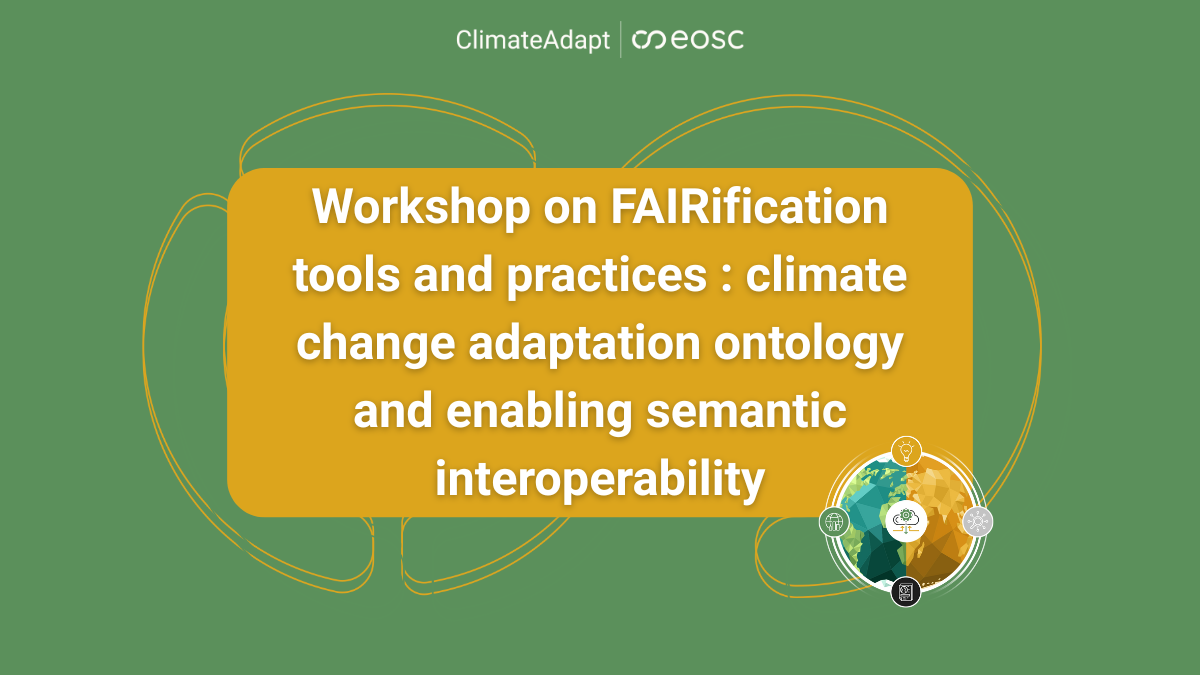
On 19 December 2025, the third Climate-Adapt4EOSC workshop on FAIRification Tools and Practices took place, focusing on Climate Change Adaptation Ontology and the role of semantic interoperability in accelerating climate resilience research. The workshop was delivered by Dr Feroz Farazi from the University of Cambridge.
As climate risks intensify across Europe and beyond, the ability to rapidly generate robust, evidence-based insights has become increasingly dependent on the availability of data and services that comply with the FAIR principles—Findable, Accessible, Interoperable and Reusable. Ensuring that climate data can be easily discovered, accessed, combined and reused across platforms is essential to support advanced simulations, predictive modelling and informed policymaking.
A central theme of the workshop was semantic interoperability, identified as a critical enabler for integrating heterogeneous climate-related datasets and services. Semantic interoperability allows data from different sources, disciplines and systems to be interpreted consistently, thereby facilitating seamless reuse across analytical tools and infrastructures. This capability is particularly important for climate adaptation, where decision-making relies on the combined analysis of diverse datasets, such as climate indicators, socio-demographic information and spatial data.
During the session, Dr Farazi presented the Climate Change Adaptation Ontology, developed to provide a unified semantic framework for representing and linking a wide range of climate-relevant datasets. The ontology supports multiple dimensions of interoperability, including harmonised querying, structured data integration and consistent interaction between tools and services. By establishing shared semantic definitions, it reduces ambiguities in data interpretation and enables more efficient cross-platform analyses.
The workshop also highlighted the practical application of the ontology within climate resilience and adaptation initiatives, including the Climate-Adapt4EOSC project. By enabling consistent data exchange and low-cost data export across systems, the ontology contributes to more streamlined workflows, enhanced modelling capabilities and improved decision-support tools. These advances are expected to strengthen the capacity of researchers, practitioners and policymakers to anticipate climate impacts and design effective adaptation strategies.
Overall, this third workshop underlined the strategic importance of FAIRification and semantic interoperability for climate change adaptation. By fostering coherent data ecosystems and interoperable services, such approaches play a key role in advancing climate resilience planning and supporting actions aimed at protecting populations and ecosystems across Europe and globally.
To stay informed about future updates, subscribe to the YouTube channel. You can also follow project updates via our LinkedIn.